
Affirmation by Default
What the detransitioners reveal about the UK Conversion Practices Bill

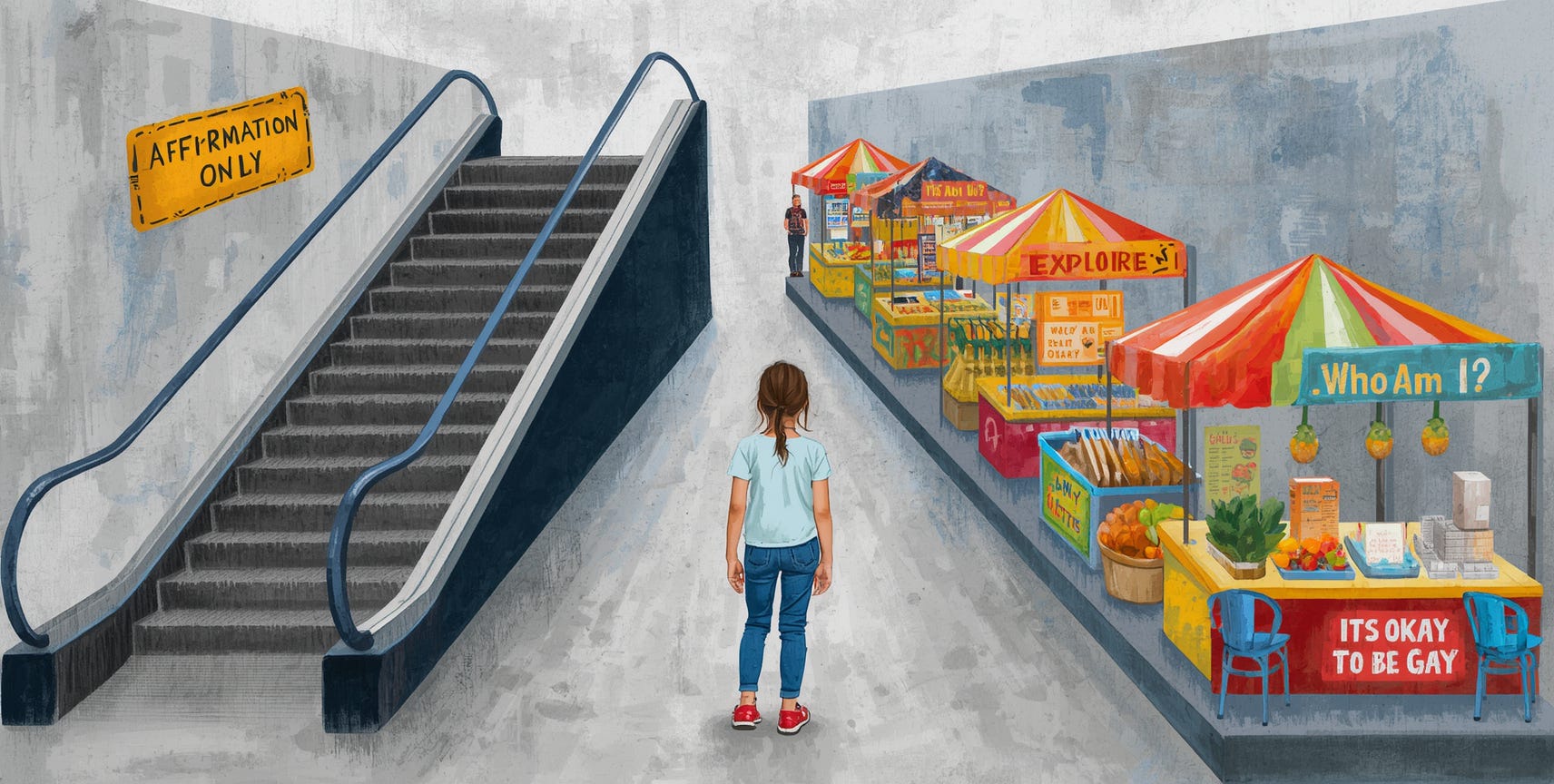
Ask a lesbian in her fifties what would have become of her if she had grown up now, and a striking number give the same answer: she would have transitioned. A gender-nonconforming girl, uncomfortable in herself and attracted to other girls, would have been read - and would have read herself - as a boy. It is an observation that has circulated in lesbian and gay circles for years without reaching much of the public. The detransition studies now give it an evidence base.
In Lisa Littman’s 2021 survey of 100 detransitioners, almost a quarter - 23% - described homophobia or difficulty accepting themselves as lesbian, gay, or bisexual as part of why they transitioned and later stopped. They were not asked about it. They raised it themselves. Littman’s account of that group includes people who assumed they were transgender because they had not yet understood themselves to be gay. In Elie Vandenbussche’s 2022 survey of 237 detransitioners, 52% reported a need to learn to cope with internalised homophobia. In a 2023 Canadian study in PLOS ONE - not a gender-critical source, and sympathetic to affirming care - participants described transition as a way to escape being female, and reflected that theirs may have been driven by a homosexuality they could not accept, or by autism or trauma their clinicians never explored.
The pattern is consistent. A same-sex attracted child cannot bear, understand, or accept being gay. Transition offers a way to make the conflict disappear. The girl attracted to girls becomes a straight boy; the boy attracted to boys becomes a straight girl. The attraction is not resolved through acceptance. It is dissolved by moving into a category where it no longer reads as homosexual.
No one’s orientation is changed. These young people remained same-sex attracted - which is how they came to recognise what had happened, and often why they detransitioned. What changed was not who they were attracted to but how that attraction was read: a lesbian reconstituted as a heterosexual man. The direction is the one old conversion therapy always aimed at - a gay child steered away from a gay future - reached by the opposite route. No one set out to do it. The de-homosexualising is a byproduct of affirming a cross-sex identity.
These are people who detransitioned, not a cross-section of everyone who transitions, and most who transition do not detransition. So the studies do not tell us how common this is. They tell us it is real, and not rare among those it touches. For a question about children, that is enough to matter.
What the Bill can and cannot see
The Conversion Practices Draft Bill (CP 1604, June 2026) defines a conversion practice as conduct carried out “with the intention of” changing someone’s sexual orientation or transgender identity, or their belief about either. Everything turns on those four words. It is an intention test, not an effects test.
Old-style conversion therapy meets it easily. Someone sets out to make a gay person straight; the intent is the whole point. That practice is real, it is harmful, and the Bill catches it.
The pathway the detransitioners describe does not meet it. The adults affirming a distressed girl intend to affirm her gender identity. They do not intend to change what she believes about her sexuality - even though that is the effect, and even though the Bill’s own words describe it: causing a person to believe that they do not have a particular sexual orientation. The result sits inside the definition. The intention requirement keeps it out.
Two further features seal the gap. The Bill only bites on conduct that is abusive - coercive, threatening, pressuring. Affirmation presents as the opposite: warm, validating, received as care. And clinical conduct is exempt altogether unless it falls “far below the standards reasonably expected.” Affirmation before exploration has been the standard. So the one pathway most likely to steer a gay child away from a gay future is the pathway the Bill protects - by default, and as a mark of good clinical standing.
The same filters run the other way for exploration. A therapist who helps a child sit with distress, rather than affirm a new identity, is easier to cast as trying to change a transgender identity, and easier to accuse of emotional pressure. The Bill’s words are even-handed between affirming and questioning. Its architecture is not. Affirmation passes through untouched. Exploration is the conduct left exposed.
A safeguarding question
The Bill’s own machinery points elsewhere. Its protection orders can be sought by a local authority or the police and made in the family courts, to secure a child’s health, safety and wellbeing. That is the language of safeguarding. And safeguarding asks a different question than affirmation does.
Not: was this child affirmed or questioned? But: before a cross-sex pathway was set in motion, social or medical, did anyone seriously explore what the distress was about? Same-sex attraction and shame about it. Gender-nonconformity. Trauma. Autism. Misogyny. Bullying. Family or community shame. Where that exploration does not happen, affirmation becomes a route away from a homosexual outcome - not through anyone’s cruelty, but as the default setting of a system that never asked the question.
For children, the stakes are not hypothetical. The long-standing finding is that most gender-distressed children, left alone, grow comfortable in their own bodies, and a large share grow up gay. The Cass Review found that social transition is not a neutral act, and recorded clinicians’ unease that, for some children and families, a trans identity had become easier to accept than a gay or lesbian one. Affirming that identity as the default does not settle a child’s distress about being gay. It removes the child from the category before the question is ever asked.
A conversion ban is meant to stop adults steering children away from who they are. This one is built to catch the coercive practice of the past and to wave through the affirming one of the present - the one the detransitioners keep describing. None of it requires anyone to have intended harm. It requires only that the Bill, as drafted, cannot see it, and that the children least able to speak for themselves are the ones it leaves out.
Sources: Littman (2021), Archives of Sexual Behavior; Vandenbussche (2022), Journal of Homosexuality; MacKinnon et al. (2023), PLOS ONE; Cass (2024), Independent Review of Gender Identity Services for Children and Young People; Conversion Practices Draft Bill (CP 1604), Cabinet Office, June 2026.
Children are not sexually attracted to anyone until they hit puberty and even then. I'm having trouble with this language. What am I missing?