
Transgender Identity: A Definition Without an External Test
The UK Draft Conversion Practices Bill writes an untestable idea into criminal law, then asks decisions about children’s medical care to rest on it.

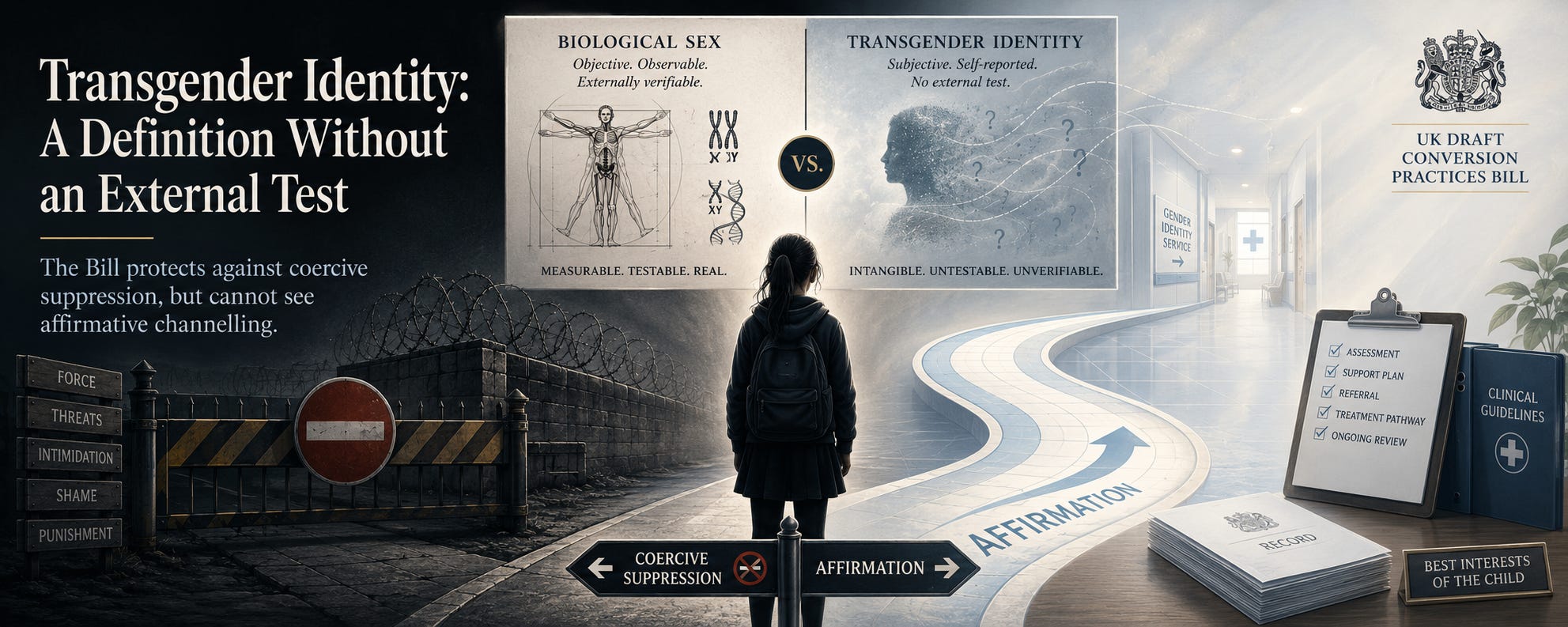
In April 2025 the UK Supreme Court held that “sex” and “woman” in the Equality Act 2010 refer to biological sex - a characteristic that can be verified against observable criteria. In June 2026 the government published a draft Conversion Practices Bill that, for the first time in UK statute, gives legal content to “transgender identity.” The definition includes a person who “identifies as neither male nor female or as not solely male or female.” This limb rests solely on self-report.
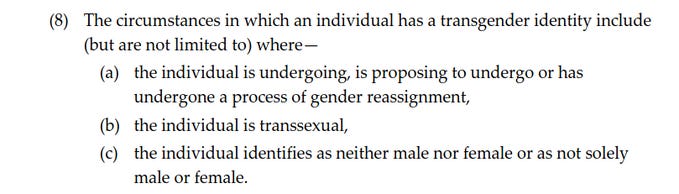
Conversion Practices Draft Bill - Transgender Identity Definition
The same legal system now treats one category as objectively ascertainable and another as effectively non-falsifiable, while attaching both criminal consequences and children’s medical pathways to the latter.
On the face of it, the Bill does not readily criminalise ordinary statements of biological fact or clinical caution. Its offence requires abusive conduct, specific intention to change a person’s belief about their transgender identity, and serious harm or substantial distress affecting daily life. The difficulty lies not in the thresholds themselves but in the category the Bill chooses to protect and the domains into which it imports that category.
The new statutory definition
Until now, UK law has protected “gender reassignment” - a process - rather than a free-standing identity. The draft Bill defines “transgender identity” to include a person who is undergoing or has undergone reassignment, who is transsexual, or who identifies as neither male nor female or not solely male or female. The list is expressly non-exhaustive. The final limb is defined by the individual’s own account and has no external test by which it can be confirmed or disproved.
A definition’s primary function is to permit verification in a given case. “Adult human biological female” can be tested against physical criteria. “A person’s sense of being neither male nor female” cannot. No state of affairs external to the report could demonstrate that the description does not apply. In anti-discrimination law this feature is not disabling: the law protects religious belief and political opinion without requiring an objective test of their truth. The relevant question is whether adverse treatment occurred because of the claimed belief.
The position changes when the same category is imported into domains that requiring operational decisions — clinical pathways, consent, or criminal liability. There the absence of an external test ceases to be neutral.
Consent and the healthcare exemption
UK consent law, as stated in Montgomery v Lanarkshire Health Board[2015] UKSC 11, requires disclosure of information that a reasonable person in the patient’s position would consider material. This includes risks, alternatives, and the option of no treatment.
A pathway of social transition followed by puberty suppression and cross-sex hormones rests on the premise that the child has a transgender identity that ought to be affirmed as a settled fact. After the Cass Review (2024), that premise has a weak evidence base and no agreed diagnostic test or biomarker. Whether that premise is as robust as presented is information a reasonable parent would likely consider significant. Under Montgomery, it is therefore material.
The Bill’s healthcare exemption provides that clinical conduct is not a conversion practice unless it “falls far below the standards reasonably expected.” This test measures conduct against prevailing practice. Where prevailing practice is affirmation, the exemption protects the very approach whose evidential foundation is contested. It reinstates the “what doctors usually do” standard that Montgomery rejected in favour of what a reasonable patient needs to know.
The Minister has observed that a person cannot consent to abuse. That proposition is not in dispute. The issue is the prior duty to disclose material information about the premise on which treatment is offered.
The developmental pathway the Bill cannot reach
The Bill’s definition of conversion practice includes conduct intended to cause a person to believe they do not have a particular sexual orientation.
Picture a girl of twelve or thirteen, uneasy in her body as puberty arrives, starting to notice she is drawn to other girls, with no steady language for any of it. An explanation is available to her everywhere - from friends, from school, from the clinic: the discomfort means she is really a boy. Her self-description is treated not as something to be understood over time but as a fact to be affirmed now. Her name changes, her records change. Everyone is kind. And a possible future - growing into a lesbian woman at home in her own body - is not forbidden to her. It is simply bypassed, before she ever reaches it.
A same-sex attracted girl who comes to understand herself as a heterosexual boy has come to hold precisely that belief. The outcome falls within the statutory language.
The Bill nevertheless cannot address this pathway. It tests intention rather than effect. Adults who affirm the child’s stated gender identity intend to support that identity. The filters trigger on abuse, violence, threats and coercion. But the forces that channel this child are soft, cumulative and unlikely to look like any of those. The Bill requires serious harm now, while the harm of this pathway tends to arrive years later, as physical injury, regret, detransition or confusion about a sexuality that was never allowed to develop. Its protection orders are also safeguarding machinery pointed in one direction. Sought by police or councils and made in the family courts, they can treat a parent’s hesitation to affirm as the risk to be managed. The channelling itself, because it takes the form of affirmation, remains invisible.
The Cass Review recorded clinical concern that, for some children, a trans identity had become more readily accepted than a gay or lesbian one. Detransition studies illustrate the mechanism when it occurs. Surveys of detransitioners have recorded unprompted reports of internalised homophobia or difficulty accepting same-sex attraction as factors in transition and later detransition. The argument does not require precise prevalence data. It requires only the narrower proposition, accepted even by critics of the desistance literature, that identity in childhood is frequently unsettled and that treating it as settled can close futures that remained open.
The objection and the missing third position
The principal objection is that gender identity is innate, so affirming it protects a real trait while questioning it constitutes conversion - conduct the Bill’s other limb is intended to capture.
This response requires no general claim that gender identity does not exist or cannot be stable in adults. It requires only the narrower proposition that, in childhood, the picture is often not yet fixed. That is the proposition the objection must deny. Immutability is assumed by the affirming position rather than required by the Bill, which equally prohibits conduct intended to cause a child to acquire a transgender identity. Declining to settle the question for a child is not suppression; it is a refusal to make irreversible social and medical decisions on the child’s behalf while development remains fluid. A law that cannot distinguish between these two stances treats patience as harm.
The Bill therefore operates with only two recognised positions: suppression and affirmation-as-direction. It leaves unaddressed the third: taking the child’s distress seriously while declining to resolve the identity question prematurely. That stance keeps the widest range of futures reachable for as long as possible.
Conclusion
The legal system is simultaneously affirming that biological sex is an objective, verifiable characteristic for the purposes of the Equality Act and constructing criminal offences and clinical pathways around a category whose core element cannot be verified externally and can directly contradict that characteristic. The girl whose distress is real and whose development remains open, sits between these two positions. The Bill would protect her from coercive attempts to suppress a transgender identity. It contains no mechanism to address the institutional and clinical process that may settle her into being trans before she has had the opportunity to explore alternatives, before she has a chance to find out who she is.
Sources: Draft Conversion Practices Bill (CP 1604), Cabinet Office / Office for Equality and Opportunity, June 2026; For Women Scotland Ltd v The Scottish Ministers [2025] UKSC 16; Montgomery v Lanarkshire Health Board [2015] UKSC 11; Cass, Independent Review of Gender Identity Services for Children and Young People (2024); Littman (2021), Archives of Sexual Behavior; Vandenbussche (2022), Journal of Homosexuality; MacKinnon et al. (2023), PLOS ONE.
Helpful paper. Affirmation of a "gender identity," (that which cannot objectively verified, nor which has been proven to actually exist as a thing) is a conversion practice, it takes difficult or uncomfortable feelings and converts it into an identity, a permanent identity state). What this bill (in its draft form) does is to protect gender ideologues from any potential legal consequences of affirming an ideologically constructed identity. The genderists can peddle their quackery with impunity...